

1. Time-Saving Organization Tips That Actually Reduce Effort
Most organization advice promises to save time, but much of it quietly does the opposite. It adds steps, introduces new systems, or requires ongoing attention that busy people simply don’t have. Truly effective time saving organization tips don’t ask for more effort upfront — they reduce effort overall. They work by eliminating friction, shortening decision paths, and preventing problems before they appear.
One reason many tips fail is that they focus on activity instead of impact. Rearranging shelves, labeling everything, or creating detailed categories can feel productive, but if these actions don’t reduce daily effort, they aren’t time-saving. In fact, they often increase maintenance time. Effective tips are judged by one question: Does this make organization faster tomorrow? If the answer is no, the tip is likely costing more time than it saves.
High-impact time-saving tips usually involve subtraction rather than addition. Fewer categories mean faster decisions. Fewer storage locations mean less searching. Fewer rules mean less hesitation. Each removed step shortens the time it takes to put things away and reduces the chance that the task will be postponed. Over time, these small time savings compound significantly.

Another key principle is aligning organization with natural behavior. People instinctively choose the fastest option available, especially when busy. Tips that fight this tendency fail quickly. Tips that work with it succeed quietly. Placing storage exactly where items are used, allowing broad placement instead of precise sorting, and accepting “good enough” outcomes all reduce the time cost of organization in everyday moments.
Effective time saving organization tips also focus on prevention. The fastest way to organize is to avoid needing to organize later. When items are returned immediately because it’s easy to do so, clutter doesn’t build up. This prevents the need for larger organizing sessions that consume far more time than small daily actions ever would.
Another overlooked aspect is decision speed. Tips that reduce thinking save time even if the physical action stays the same. Knowing instantly where something belongs is faster than deciding, even if the distance is identical. This is why clear, simple systems outperform complex ones in real life.
Finally, time-saving tips reduce emotional resistance. When organization feels light and quick, people engage with it more often. There’s no mental buildup or avoidance. Organization becomes part of normal movement through the day instead of a separate task that requires planning.
Ultimately, time saving organization tips that actually work don’t rely on discipline or extra effort. They save time by making organization easier, faster, and more natural — not by asking people to do more, but by designing systems that demand less.

2. Why Most Organization Tips Waste Time Instead of Saving It
Many organization tips are marketed as shortcuts, yet they quietly consume more time than they return. This happens because most tips focus on surface-level improvement rather than long-term efficiency. Understanding why this occurs is essential when evaluating which time saving organization tips are actually worth following.
One common issue is that many tips add complexity. They introduce new containers, extra categories, or detailed rules that must be learned and maintained. While these tips may create a sense of order initially, they often increase the time required to interact with the system. Every additional step, label, or decision adds seconds that accumulate throughout the day.
Another reason organization tips waste time is that they prioritize appearance over function. Tips designed to create visually pleasing results often require constant upkeep to maintain that look. Straightening, re-aligning, and correcting small details may look productive, but they rarely make daily organization faster. In many cases, they create more work than disorder itself.
Short-term thinking is also a problem. Tips that promise quick wins often ignore how behavior repeats over time. A solution that saves time once but requires regular resetting is not time-saving in the long run. These tips trade immediate satisfaction for ongoing maintenance costs that quietly drain time.
Many tips also fail because they ignore real behavior. They assume people will slow down, be intentional, and follow rules consistently. In busy life, this assumption doesn’t hold. Tips that rely on ideal behavior are skipped under pressure, making them ineffective exactly when time matters most.
Effective time saving organization tips avoid these traps by focusing on reduction, alignment, and sustainability. They save time not by optimizing moments, but by preventing friction and repetition. When a tip reduces how often you need to organize — not just how it looks — it truly earns the label “time-saving.”
3. Identifying High-Impact Organization Actions
Not all organization actions are equal. Some consume time without changing outcomes, while others quietly reshape daily behavior and save time repeatedly. Identifying high-impact actions is essential for applying time saving organization tips that actually make a difference. High-impact actions are those that reduce future effort, not just create temporary order.
A high-impact organization action changes what happens next. It shortens the time it takes to put things away, reduces how often clutter forms, or eliminates a repeated problem entirely. In contrast, low-impact actions focus on rearranging, refining, or perfecting what already exists without altering daily behavior. These actions may look productive, but they rarely reduce time spent organizing tomorrow.
One way to identify high-impact actions is to look for friction points. Where do items consistently land instead of being put away? Where do decisions slow you down? Actions that remove friction at these points — by moving storage closer, simplifying categories, or clarifying placement — tend to have lasting effects. They change the default behavior, which is where real time savings come from.
Another indicator of high impact is repetition. Actions that affect behaviors repeated multiple times a day save far more time than actions applied occasionally. Saving five seconds on something done ten times a day is more powerful than saving five minutes on something done once a month. High-impact organization targets frequency, not size.
High-impact actions also tend to be simple. They don’t require ongoing attention or perfect execution. Once implemented, they work quietly in the background. This is a key trait of effective time saving organization tips — they continue saving time without asking for more of it.
Ultimately, identifying high-impact actions means shifting focus from visible effort to invisible results. The best organization actions are often the least noticeable, but they are the ones that keep paying back time every single day.
👉 Simple & Time-Saving Organization

4. Small Organization Changes That Save Time Every Day
Some of the most powerful time saving organization tips come from small changes rather than big projects. These changes don’t require reorganizing entire spaces or investing hours of effort. Instead, they adjust everyday interactions just enough to remove friction — and that friction reduction saves time repeatedly.
Small changes matter because they operate at the level of daily behavior. Moving a frequently used item a few steps closer, widening a category so decisions are faster, or removing an unnecessary container can shave seconds off routine actions. Those seconds may seem insignificant in isolation, but when repeated dozens of times a day, they add up to meaningful time savings.
One key characteristic of time-saving small changes is that they reduce hesitation. When an action feels obvious, it happens immediately. For example, if an item has one clear home instead of several possible ones, there’s no pause to decide. Eliminating that pause saves mental energy as well as time, which is especially valuable on busy days.
Another benefit of small changes is that they are easier to maintain. Large organization projects often require motivation and follow-up. Small adjustments blend into daily life. Once made, they continue working without attention. This makes them ideal for people who don’t have time to constantly manage systems.
Small changes also lower the barrier to starting. Because they feel manageable, people are more likely to implement them consistently. This consistency is what allows time saving organization tips to deliver long-term benefits. A small change applied consistently outperforms a large change applied occasionally.
Importantly, small changes are easier to reverse or adjust. If something doesn’t work perfectly, it can be tweaked without starting over. This flexibility encourages experimentation and prevents the paralysis that comes with high-stakes organizing decisions.
Ultimately, saving time every day doesn’t require dramatic transformation. It requires thoughtful, targeted adjustments that make common actions faster and easier. Small organization changes work because they respect real life — and over time, their impact becomes surprisingly large.
5. Reducing Setup Time in Daily Organization
One of the most overlooked drains on time is setup. Many organization approaches require preparation before they can even be used — opening containers, clearing space, sorting items, or “getting ready” to organize. When setup time is high, organization gets postponed. Effective time saving organization tips focus on reducing or eliminating setup altogether, so organized behavior can happen instantly.
Setup time creates friction at the worst possible moment. When someone is busy or tired, even a small barrier can stop action. If putting something away requires clearing a surface first or opening multiple containers, the brain registers it as work and chooses to delay. Reducing setup time removes that resistance and allows organization to happen in real time.
One way to reduce setup is by keeping systems always ready. Storage should be accessible without preparation. Containers shouldn’t need rearranging before use, and surfaces shouldn’t need to be cleared just to put something away. When systems are “open by default,” interaction becomes fast and natural.
Another important factor is avoiding temporary steps. Many people rely on holding areas — piles, trays, or “deal with later” spots — that require a second round of organization. While this feels convenient in the moment, it doubles the time spent handling the same items. Reducing setup means designing systems that allow items to go directly to their final place the first time.
Reducing setup time also simplifies recovery. When systems are easy to engage with immediately, restarting organization after a busy period takes seconds instead of minutes. There’s no mental or physical preparation required, which lowers resistance and increases consistency.
Ultimately, time saving organization tips succeed when they remove the need to prepare. Organization that works instantly is organization that actually happens. By eliminating setup time, organization becomes part of normal movement through the day — fast, automatic, and sustainable.

6. Organization Tips That Work on Busy Mornings
Busy mornings are where most organization advice breaks down. Time is limited, attention is divided, and energy is already being spent on priorities outside the home. Time saving organization tips that truly work must function under these conditions, not require calm, focus, or extra steps. If a tip can’t survive a rushed morning, it isn’t time-saving in real life.
The first principle is immediacy. On busy mornings, there is no room for preparation or decision-making. Organization tips that work are those that allow actions to happen instantly. Items must have obvious, easy-to-reach homes, and returning them must be faster than setting them down somewhere else. When the organized option is the quickest option, it still happens under pressure.
Another important factor is tolerance. Busy mornings are imperfect by nature. Systems that require precision or full completion fail immediately. Effective tips allow partial success. Putting one item away still counts. Leaving something slightly out of place doesn’t break the system. This tolerance prevents small disruptions from escalating into visible chaos.
Busy-morning organization also depends on minimizing steps. Every extra action — opening, sorting, rearranging — is a barrier. Tips that work remove those steps. Broad placement, open access, and minimal handling keep actions short and repeatable. This saves not just time, but mental energy, which is often more limited than time itself.
Predictability matters as well. When organization is consistent, the brain doesn’t need to think. Familiar patterns allow quick action without hesitation. This consistency is especially valuable in the morning, when decision fatigue builds quickly.
Ultimately, time saving organization tips that work on busy mornings respect reality. They don’t demand calm or control. They work because they are fast, forgiving, and aligned with how people behave when time is tight. Organization that survives mornings survives everything else.
7. How to Stop Spending Time Reorganizing the Same Spaces
One of the biggest signs that organization is not truly time-saving is the need to reorganize the same spaces over and over again. This cycle wastes time because it treats symptoms instead of causes. Effective time saving organization tips aim to stop repetition by stabilizing behavior, not by perfecting layout.
Reorganization usually happens when a system looks organized but doesn’t match how the space is actually used. Items drift out of place, clutter returns, and the response is to reorganize again. This creates the illusion that the space needs constant attention, when in reality the system itself is misaligned with daily behavior. Until that misalignment is addressed, reorganization will keep repeating.
To stop this cycle, it’s essential to identify why the space keeps breaking down. Is storage too far away? Are categories too specific? Are items being used differently than expected? High-impact changes focus on removing friction at these points. When the reason clutter forms is eliminated, the need for reorganization disappears.
Another important factor is reducing over-maintenance. Some spaces are reorganized repeatedly because standards are too high. When a space must look perfect to be considered “organized,” small deviations trigger unnecessary resets. Lowering the standard to functional order saves time and allows the space to self-correct through normal use.
Consistency also matters. When systems are simple and predictable, people interact with them the same way every time. This consistency prevents drift and keeps spaces stable without intervention. Complex systems invite variation, which leads to breakdown and repeated fixing.
Ultimately, time saving organization tips that stop repeated reorganization focus on durability. A space that stays “good enough” without attention is far more efficient than one that looks perfect briefly but requires constant resets. When systems are aligned with real behavior, organization holds — and time stops being wasted on the same fixes again and again.
👉 Mistakes That Waste Time in Organization

8. Using Speed as a Measure of Organization Success
One of the most practical ways to evaluate time saving organization tips is by using speed as the main measure of success. Instead of asking whether a space looks perfect or follows an ideal system, the more useful question is: How fast can this be used and reset? Speed reveals whether organization is actually helping or quietly slowing daily life down.
When organization is effective, actions happen quickly and without hesitation. Finding an item takes seconds. Putting it away is immediate. There is no pause to decide, no need to rearrange, and no preparation required. If organization slows these basic actions, it is not saving time — regardless of how tidy it appears.
Speed exposes hidden friction. A system may look organized, but if it requires opening multiple containers, sorting into narrow categories, or adjusting items before use, it introduces delays. These delays may seem small, but repeated throughout the day they become a significant time cost. Measuring speed helps identify which parts of a system are creating that friction.
Another advantage of using speed as a metric is clarity. It removes subjectivity. Instead of debating whether a system is “good,” speed provides a clear signal. If returning an item takes longer than setting it down elsewhere, the system needs adjustment. If finding something requires searching, the system is too complex.
Speed also aligns organization with real behavior. People naturally gravitate toward faster options, especially when busy. When organized actions are the fastest available actions, consistency follows automatically. This is why time saving organization tips that prioritize speed tend to hold up under pressure.
Ultimately, speed shifts organization from aesthetics to performance. A fast system is a sustainable system. When speed is used as the benchmark, organization becomes simpler, more efficient, and genuinely time-saving in everyday life.
9. Time-Saving Organization Tips That Prevent Future Clutter
The most effective time saving organization tips don’t just make today easier — they prevent clutter from forming tomorrow. Prevention is where real time savings happen. Clearing clutter after it appears always costs more time than stopping it at the source. Tips that focus on prevention reduce how often organization is needed at all.
Future clutter usually forms in predictable ways. Items land in the same spots, decisions are postponed in the same moments, and temporary placements become permanent. Time-saving tips target these patterns directly. When an item’s default landing place is changed to an organized one, clutter loses the chance to accumulate.
One prevention strategy is shortening the decision window. The longer an item remains undecided — “I’ll deal with this later” — the more likely it is to join a pile. Tips that create immediate, obvious placement eliminate that delay. When the next action is clear, items move directly to their place instead of entering a holding state.
Another preventive approach is reducing overflow. Clutter often appears when storage reaches capacity and usability drops. Time-saving organization tips respect limits and keep systems breathable. When storage isn’t overfilled, returning items stays easy, which prevents surface buildup and repeated resets.
Prevention also depends on habit reinforcement. Tips that are easy to repeat get used consistently, and consistency prevents accumulation. A system used every day in small ways is far more effective than one used occasionally in large efforts. This steady interaction keeps clutter from gaining momentum.
Importantly, prevention saves emotional energy as well as time. When clutter doesn’t build, there’s no need for catch-up sessions that feel overwhelming. Organization stays light and manageable, which encourages continued use.
Ultimately, time saving organization tips that prevent future clutter work quietly. They change default behavior so that disorder never fully forms. By eliminating the need for repeated cleanup, these tips deliver the greatest time savings of all — not by working faster, but by making extra work unnecessary.
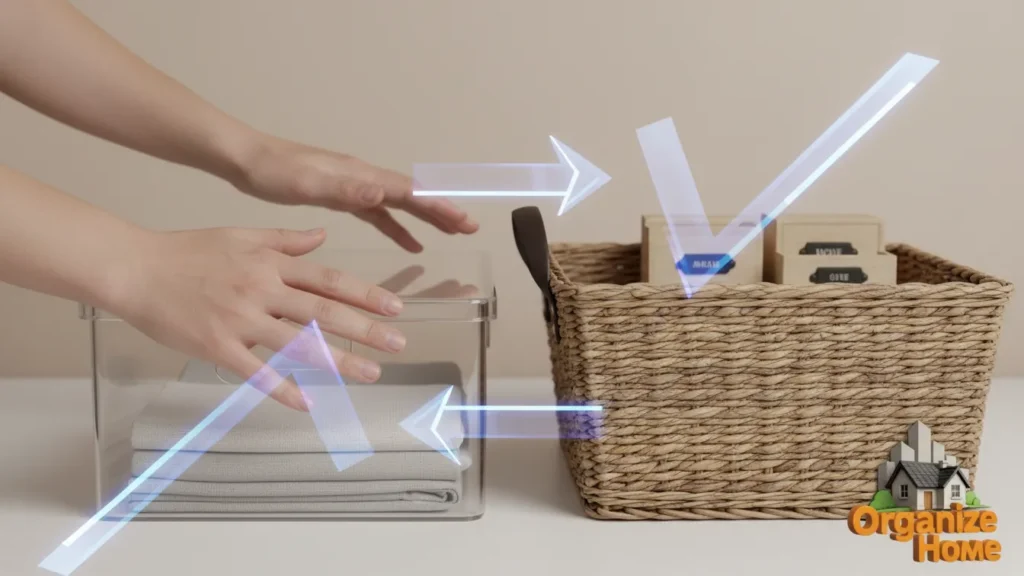
10. Eliminating Organization Steps That Don’t Add Value
One of the fastest ways to apply truly effective time saving organization tips is by eliminating steps that don’t add real value. Many organization routines include actions that feel responsible or thorough but don’t actually make daily life easier. These steps consume time without improving speed, usability, or consistency — and over time, they become hidden drains.
Non-value steps often exist because they were added gradually. Extra sorting, secondary containers, duplicate labels, or “temporary” holding stages may have seemed helpful at one point. However, if a step doesn’t reduce how long it takes to find, use, or return an item, it isn’t serving a purpose. In fact, it may be slowing everything down.
A useful way to identify low-value steps is to observe friction. Where do you hesitate? Where do you avoid engaging with the system? Steps that are skipped under pressure are usually the ones that don’t add value. If a step disappears on busy days, it likely isn’t essential for the system to function.
Another sign is repetition. If the same items are handled multiple times — placed temporarily, moved again, then finally put away — unnecessary steps are present. Time-saving organization favors direct paths. Items should move once, not cycle through stages that delay resolution.
Eliminating low-value steps also improves reliability. Systems with fewer steps are easier to remember and easier to use consistently. This consistency prevents clutter from forming and reduces the need for corrective organizing later, which is where significant time is often lost.
Ultimately, time saving organization tips work best when they simplify the process itself. By removing steps that don’t clearly improve speed or usability, organization becomes leaner, faster, and far more sustainable. Saving time isn’t about optimizing every detail — it’s about cutting what doesn’t matter.
11. Common Time Traps in Home Organization
Many people lose time in organization not because they ignore good advice, but because they fall into common time traps that look helpful on the surface. These traps quietly consume energy and create the feeling that organization is never finished. Recognizing them is essential for applying time saving organization tips that actually protect your time.
One major time trap is constant re-sorting. Repeatedly rearranging the same items into slightly different categories may feel productive, but it rarely changes daily behavior. If the system still requires effort to use, the time spent refining it is quickly lost. True time-saving organization focuses on stability, not continuous adjustment.
Another trap is organizing for rare scenarios. Creating special systems for items used occasionally adds complexity that must be maintained year-round. These systems increase decision-making and slow down everyday actions. When organization is built around exceptions instead of common use, it costs more time than it saves.
Over-maintenance is also a common issue. Straightening, aligning, and “perfecting” spaces too frequently consumes time without improving function. While these actions may improve appearance temporarily, they don’t reduce how long it takes to find or return items. Organization that requires frequent visual correction is rarely efficient.
Temporary holding zones can become another time trap. While trays or piles meant for “later” feel convenient, they often double handling time. Items are touched once to place them temporarily and again to put them away. Time-saving organization aims to reduce touches, not increase them.
Finally, chasing ideal solutions wastes time. Waiting for the perfect container, layout, or method delays action and keeps problems unresolved. Progress happens faster when systems are adjusted incrementally instead of postponed.
Ultimately, avoiding these traps allows time saving organization tips to work as intended. When time isn’t spent refining, redoing, or maintaining unnecessary complexity, organization becomes faster, lighter, and far more supportive of real life.

12. How to Build a Time-Saving Organization Mindset
A time-saving organization mindset is what allows organization efforts to remain efficient over the long term. Without the right mindset, even good systems become time-consuming because they are used in ways that add effort instead of removing it. Time saving organization tips work best when they are guided by a way of thinking that prioritizes ease, speed, and sustainability.
The first shift in mindset is valuing future time over present effort. Many organization actions feel productive in the moment but create extra work later. A time-saving mindset asks one simple question before acting: Will this make the next interaction faster? If an action doesn’t reduce future effort, it’s likely not worth the time invested now.
Another important element is accepting “good enough” outcomes. A mindset focused on perfection slows decisions and increases maintenance. Time-saving organization values function over appearance. When the goal is speed and usability, decisions are made faster, and systems remain easier to maintain. This reduces the mental load associated with organizing and keeps engagement high.
This mindset also prioritizes prevention over correction. Instead of planning time to reorganize later, it focuses on small actions that stop clutter from forming. Returning items immediately because it’s easy to do so saves far more time than setting aside hours for periodic resets. Prevention becomes the most efficient form of organization.
Flexibility is also key. A time-saving mindset expects change and adjusts quickly instead of resisting it. Systems are refined lightly rather than rebuilt completely. This prevents repeated overhauls that consume time and energy.
Ultimately, building a time-saving organization mindset means treating time as the most valuable resource. Organization is no longer about doing more or doing it better — it’s about doing less, more effectively. When this mindset guides decisions, organization naturally becomes faster, lighter, and far more supportive of everyday life.